The Science Of Perception & Intuition
#6. How to build instincts you can really trust
2 September, 2024
By Zoe Zambakides
I’ve spent years studying the neuroscience and neurobiology behind how to build instincts you can genuinely trust. I did this work on myself first, then shepherded countless clients through the same transformation and you can do the same with these fundamental steps.
Nothing is fixed. You are not a person who can trust their gut, or a person who can’t. It’s a learned skill. You can learn the discernment to know the difference between an instinct you can trust and one you should interrogate a little further.
The more you understand and practise the steps below — summarised in this series — the less you’ll need to filter your instinctive responses and the more you’ll be able to trust them and stop second-guessing yourself.
If you only have time to read this summary:
- Slow down enough to actually perceive the moment.
- Filter it through your embodied awareness, not just your thinking.
- Check in with the state of your nervous system and find a way to regulate it.
- Understand which invisible scripts might be running on autopilot in your system, and giving you an instinctual feeling that’s likely to lead you down an old path.
- Be aware of your attachment.
- Take note, and repeat.
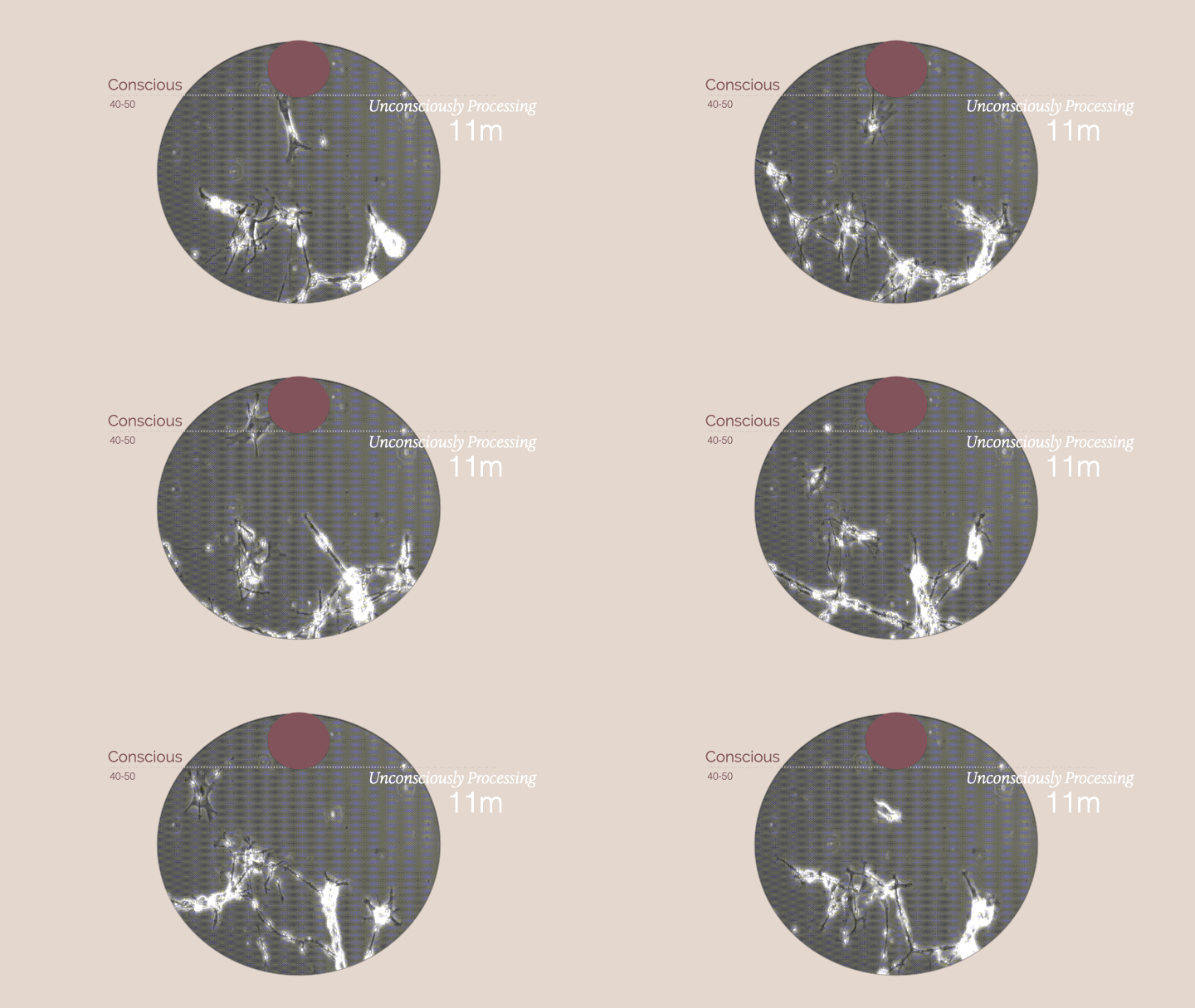
Do this consistently and you’ll be building the foundation for real confidence in your own instincts. Because repeated attention in this way fundamentally alters the neural connections around how you react and discern what to follow. Every time you practise this sequence, you build new pathways through neuoplasticity, making it feel easier each time round.
1. The foundation for great gut instincts starts with paying close attention to the present moment as it is, not as you expect it to be.
You can’t discern an instinct you’re not fully perceiving in the first place. The quality of your intuition is determined in part by how fully you can perceive all the information available to you in the moment. Building discernment about what gut feelings to trust starts with perceiving more of what’s happening around — and within — you, because your gut feeling is built from information you’re processing whether you notice it or not.
Remember the Gorilla and Dr Alison Gopnik’s lantern-versus-spotlight metaphor which gave us a visual language for how we pay attention as high-performing, fast-paced adults. Ask yourself, am I approaching this situation with child like lantern awareness or have I paid for my speed, efficiency and being knowledgeable with things I simply don’t see?
2. Trusting your instincts also starts with being able to hear them properly in the first place — which means approaching them with embodied awareness and a regulated nervous system.
Thinking with your conscious mind alone won’t cut it. Your mind is indivisible from your whole neurobiology — our bodies are part of our brains — and we’re processing millions of bits of information through them every second. As Lisa Feldman Barrett put it plainly: ‘typical self-help advice focuses on your mind and how thinking differently will change how you feel, without much consideration for your body’.
You cannot think your way to trustworthy instinct alone.
You have to slow down in a very particular way — an embodied way. Interoception — your perception of your own bodily processes — is a channel much of the deep information we need for embodied awareness reaches us through. (There is now significant evidence demonstrating links between poor or disrupted interoceptive awareness (i.e. awareness of sensory information) and emotion regulation, stress and distress (Price & Hooven, 2018). Remember, psychologists like Feldman-Barrett note that we don’t actually experience an emotion directly. We experience a cluster of sensations and our system makes a best guess at what that might be and translates it into what we experience as feeling)

So embodied self-awareness — the experience of living within and sensing through your whole bodily awareness — is crucial to building instincts you trust. Neurobiology shows that when you learn to slow down like this, and where you place your attention, it shapes the neural architecture of your whole system. This is why every step I share with people — and the foundation of what I help my clients learn — comes back to embodied awareness, not just trying to think smarter. You cannot skip this part if you really want to learn how to trust your instincts.
Movement can help too. Aside from giving your mind physical signals to process and increase your embodied awareness, physical movement helps produce brain-derived neurotrophic factor (BDNF), which supports your synapses’ ability to change over time — the new pathways you’re trying to build are easier to lay down when your body is moving regularly. That’s why a walk in the woods, a dance to your favourite tune, or simply not suppressing a natural inclination to move all help build your capacity to slow down and notice what’s happening in your embodied awareness.
3. Understand what state your nervous system is in when you’re processing what feels like an instinctive response.
As we slow down with embodied awareness, we need to become aware of the state our nervous system is in. This gives us a clue about what kind of filter we’re placing on a situation without our conscious awareness — and why slowing down matters so much.
In article #3, we covered Stephen Porges’s concept of neuroception — how your mind is constantly scanning your environment for cues of threat or safety, meaning your nervous system has already decided whether a moment is safe or threatening before you’re consciously aware of it, and that decision shapes everything you perceive next. Understanding the state your nervous system is in, and learning to come back to a sense of safety and calm, is where you can begin to make decisions not just from more information, but from a sense of calm clarity rather than reaction.
4. Becoming aware of the invisible scripts that shape how you see yourself and the world helps you build the discernment for which instincts to trust.
Most of what you perceive is prediction, not fresh data. As Dr Lisa Feldman Barrett puts it, “predictions are the basis of every experience you have.” They run fast and largely unconsciously — what Daniel Kahneman calls System 1 thinking.
There’s plenty of personal development advice focused on changing your thoughts to change your reality and on thinking things through to stop second-guessing yourself. That can be genuinely helpful in some situations — but working through your thoughts alone won’t create lasting change if your whole neurobiology continues to run on outdated algorithms rooted in past experience. We all have them.
If thinking more isn’t helping, that’s undoubtedly where some of your opportunities lie. Remember, the trickiest ones often run totally counter to who you think you are, or your conceptual sense of self. Approaching it with embodied self-awareness always holds new information.
In article #5, we went to the root of where some of the strongest and deepest scripts and predictions come from: your childhood attachment. This is our unconscious programming around how we expect to be seen, and it shapes how we see ourselves, how we need to be in order to be successful, and how we respond to others. This isn’t psychology-101 textbook stuff — looked at just from a work point of view, it’s been shown to predict burnout, job performance and job satisfaction (Warnock, Ju and Katz, 2024). It’s shaping your working life right now and how you’re second-guessing yourself.
From the countless clients I’ve supported, I can tell you: if this applies to you, it’s affecting what feels like your instincts too.Gut says this new colleague isn’t to be trusted, or your boss is annoyed, or you really need to check your email right now? That might be your attachment algorithms running overtime and an instinct to be more curious about.
Learning to discern what might be driving you from your attachment is one of the most empowering things you can do — to tell an instinct worth following from one that might be leading you down an old, sometimes unnecessary, path.
Building unshakable trust in yourself and your instincts
You know the drill now.
Slow down enough to perceive clearly. Filter it through embodied awareness. Regulate your nervous system. Discern the scripts and attachment patterns running underneath.
This isn’t an overnight fix. But for those who are ready and willing to hone these skills of discernment, a deep reservoir of confidence will build within you and you’ll never find yourself lying awake at 1am wondering whether you can trust your instincts again.
Living a life that unfolds from instincts you have really learned to listen to…
Everything in this series so far has been about learning how to discern a gut feeling that you can trust, from one that is an old pattern that might pull you back.
Followed consistently, when you start to live life from these discerned instincts, and learn to mine them even deeper, they will often take you to places you cannot consciously image. All that’s required is the discernment to tell a pull toward the future from an old pattern pulling you back and trusting the pull enough to actually follow it.
This is what unfolds when the discernment actually holds: a life that keeps opening in ways you couldn’t have consciously predicted, unfolding on its own terms rather than a plan executed on schedule – and that’s how I built ToTheInvisible. But that story is for another day…
Need to some support to start?
Most people find that they need a friendly support helping them through the next step. I created PAUSE for my clients to do just that— a 30-day audio journey that gently guides you out of autopilot. With each daily audio – not more than 10 minutes a day – you’ll learn to slow down in a subtle and powerful way- to pause the noise of life, notice the invisible information within and around you, and act from a place of calm clarity — without any elaborate practices or having to get on a meditation mat
If you’d like to listen to the Welcome Audio and Day One, you can do as a gift from me, here.
References:
Fugate, Jennifer & Macrine, Sheila & Hernández-Cuevas, Eva. (2024). Therapeutic Potential of Embodied Cognition for Clinical Psychotherapies: From Theory to Practice. Cognitive Therapy and Research. 48. 1-25. 10.1007/s10608-024-10468-y.
Price CJ, Hooven C. Interoceptive Awareness Skills for Emotion Regulation: Theory and Approach of Mindful Awareness in Body-Oriented Therapy (MABT). Front Psychol. 2018 May 28;9:798. doi: 10.3389/fpsyg.2018.00798. PMID: 29892247; PMCID: PMC5985305.
Miranda, M., Morici, J. F., Zanoni, M. B., & Bekinschtein, P. (2019). Brain-Derived Neurotrophic Factor: A Key Molecule for Memory in the Healthy and the Pathological Brain. Frontiers in Cellular Neuroscience, 13, 363. https://doi.org/10.3389/fncel.2019.00363
Warnock KN, Ju CS, Katz IM. A meta-analysis of attachment at work. J Bus Psychol. 2024;39(6):1239-1257. doi:10.1007/s10869-024-09960-9