The Science Of Perception & Intuition
#2. You are processing mountains of invisible information that can help you to discern what instincts to trust
15 August, 2024
by Zoe Zambakides.
The quality of your intuition is determined in part by how fully you can perceive all the information available to you.
Building discernment about what gut feelings to trust starts with perceiving more of what is happening around – and within you – because your gut feeling is built from information you’re processing whether you notice it or not.
In every waking second you are absorbing millions of bits of information beyond what is visible to your conscious awareness. That information shapes how you experience the world, your sense of self and the quality of the feelings you call instincts or intuition.
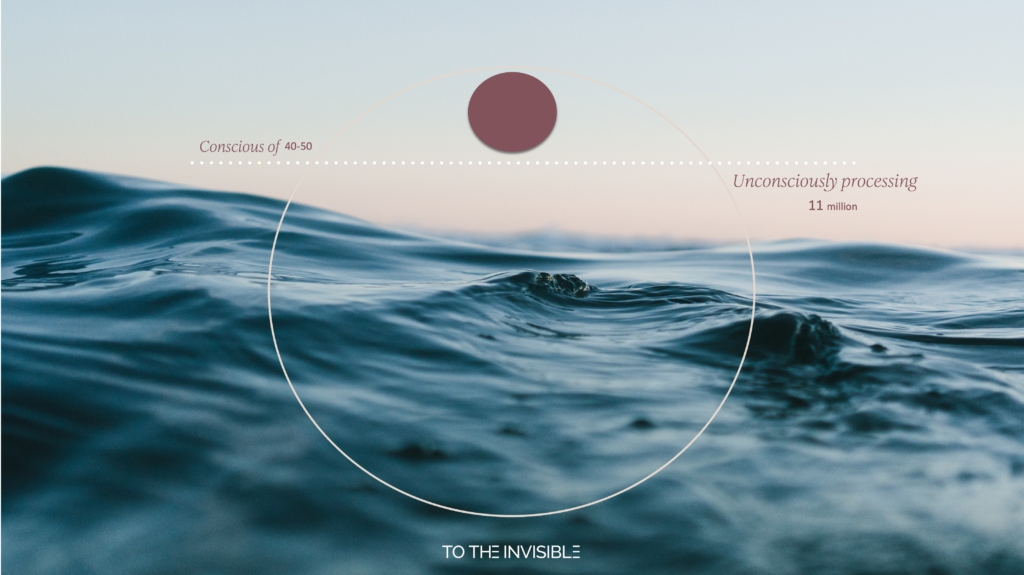
We are all picking up far more information about any given situation than we are aware of and it plays a huge part in who we feel we ‘are’, what guides our moment-to-moment choices and how we experience life.
“Our eyes alone receive and send over 10,000,000 signals to our brain each second”
– Dr Timothy Wilson, 2002
Through its five senses your body receives over 11million bits of information in every moment, yet (even the most liberal estimate) is that we can only consciously process about 40-50 of those in any given second (Wilson 2012).
For example,
- Studies have shown that our bodies can detect stress in someone’s sweat and it shapes how warm or competent you perceive them to be — before you’ve consciously registered anything
- Other studies have shown that being in the presence of other people who feel stressed can trigger the same physiological response in us.
- When we co-sleep with a loved one our heart rhythms have shown to fall into the same rhythm
- As we really listen and talk empathetically with others our brain waves start to synchronise
- Being primed with stimuli we’re not conscious of can affect our mood accordingly,
- Aggression has been shown to rise as the ambient temperature around us does, and
- A mountain of cognitive bias research affirms that no single human is immune from the impact of unconscious processing on their conscious thought.
You can have the strongest sense of who you are and still be shaped, moment to moment, by information you never consciously registered, and being aware of this is part of starting to know when to trust you instincts.
why slowing down helps us trust our instincts
“we have to slow – down …”
– Dr. Jennifer Eberhardt (2020)
At a talk I attended in 2019 Dr Jennifer Eberhardt of Stanford, one of the world’s leading experts in unconscious bias, was asked how to tackle bias in what we see. Her answer: slow down.
Nextdoor, the neighbourhood app, came to her with a problem — a disproportionately high number of posts along the lines of “there’s a suspicious man in our neighbourhood,” with an obvious racial skew. On her advice, they introduced two questions that forced a pause before anyone could post. A little like the orienting we mentioned in #1:
- What is this person doing that makes them look suspicious?
- Describe their physical features (not just race and gender)
- They then introduced a descriptor of unconscious racial profiling to prompt people’s conscious awareness of it.
That was it. Two questions, forcing one pause, and some context, before an unconscious cue got acted on — the same principle as the Orienting practice from #1. Their moto became, if you see something suspicious, say something specific. Racial profiling on the app dropped by 75% (Eberhardt, 2019).
This is what happens when you build in a moment to check what’s actually driving a reaction, being aware of what might be affecting it, rather than blindly trusting the first impulse that comes in a millisecond. That’s also how conscious thought and action can contribute to not second guessing yourself.
We are all used to travelling so fast.
How many of your expectations – about strangers on our street or your own path to success – have you consciously chosen? And how often do we really slow-down to check?
Most of us never slow down long enough to find out whether our gut is reading the moment accurately, or running on an old assumption we never chose.

Why ‘thinking harder’ doesn’t get you to trusting your gut.
There’s been a lot of research and literature popularising the understanding that our conscious ‘thinking’ lives alongside another kind of ‘non-conscious’ thinking – often talked about as autonomic thinking. Behavioural economists have looked at how we can nudge behaviour, prime people to make different choices – it’s hugely related to the field of popular psychology.
However, that alone really does not do justice to the reality of the situation when it comes to really understanding ourselves and reaching new thresholds in our personal development and self-understanding.
If so much of our experience is shaped outside of our conscious awareness, how can we ever know ourselves?
If you want to develop intuition you can really trust and discern what is a pattern that might pull you back, and what is a thread that can take you to unimaginably brilliant places – you have to be prepared to go deeper and learn how to cultivate embodied awareness.
Some people I talk to find this a deeply uncomfortable thought. It often brings up a host of sensations and thoughts: ‘oh my , what’s really under there? Can I know myself? Do I want to?’.
For many people I work with, and me when I started this journey, this is where the fear can kick in. You’ve tried so hard to do everything right, you’ve spent your life trying to become more self aware. You’ve read the mindset book, done the coaching, reflected endlessly.
But there often comes a moment in our life, or moments, when we can’t think ourself into the next step. What has got us here, will not get us to where we want to go. The conclusion is often that we need to try harder. But when you follow the neuroscience, I believe it shows us that the opposite is true. It isn’t to ‘think’ harder, but to perceive more – by doing it differently.
Jospeh Campbell said ‘the cave you fear to enter holds the treasure you seek’.
WHY THINKING OFTEN WON’T STOP YOU SECOND GUESSING YOUR GUT
“We perceive the world around us, and ourselves within it, with, through, and because of our living bodies”
– Dr Anil Seth (2021)
We tend to assume self-trust comes from knowing what we think.
It doesn’t.
True self-awareness starts with recognising that what you ‘think’ is only a fraction of the picture — one expression of what your whole system already knows.
If you were raised in a Western culture, you were most likely taught that your unconscious lives in your brain and your brain is in the driving seat. The neuroscience says otherwise: perception, cognition and emotion are entangled across your entire bodily system, not contained in your skull (Pessoa, 2022) — more on this in Principle #3.
Dr Timothy Wilson, who coined the term ‘adaptive unconscious’, frames the scale of this well: imagine your unconscious took a holiday. You’d struggle to get out of bed without falling over — that’s proprioception. You’d have no filter for what to pay attention to at all — that’s the lantern-perception problem from #1. Understanding language, feeling an emotion — none of it happens without unconscious processing running constantly in the background.
Two ways of knowing yourself and the second foundation for discerning instincts you can trust
“The problem is that the mind is part of the body and the body has a mind of its own”
– Dr Alan Fogel (2009)
Next Doors Reporting questions are not dissimilar to what anyone interested in widening their sense of self-awareness in any moment might ask.
Dr Alan Fogel of the University of Utah distinguishes between two kinds of self-awareness: your embodied self-awareness — what you’re actually sensing right now — and your conceptual self-awareness — what you think about it. Most of us live almost entirely in the second. Ask someone how they feel and they’ll answer with a thought, not a sensation.
He says ‘the True Self is our embodied self-awareness, our ability to stay comfortably in the chaos of the subjective emotional present, and use that to inform our conceptual self awareness’.

Alongside widening our attention, tracking sensations in your embodied awareness is a critical bridge to understanding what is unconsciously impacting you and discerning which instincts to trust.
Next time you’re asked how you feel, try answering the question underneath it first: what am I sensing in my body, right now, before I describe it? That’s the beginning of tracking the signal your conceptual mind so often talks over.
So often when I work with clients – and myself – we will think we feel one thing, but uncover something quite different. These start to become the breadcrumbs that unearth the patterns of prediction (algorithms) that shape how we see and respond to the world. Tracking our sensations is our doorway in to knowing if its an old pattern that will pull you back, or something that will guide you to something important.
I built PAUSE to help you start to do exactly this: the capacity to notice the sensation underneath the story, so you’re perceiving the full picture rather than the fraction your thinking mind edits down to. It’s the groundwork discernment is built on.
Next: how your nervous system decides, before you’ve consciously registered anything, whether what you’re perceiving is safe to trust →: #3: understanding how your nervous system shapes how you see the world.