The Science Of Perception & Intuition
#3. You see the world through the lens of your finely tuned nervous system
15 August, 2024
The state of your nervous system can have a huge impact on how you perceive a particular moment and whether you should trust your gut or not.
Before we consciously interpret a situation, our nervous system has already decided – but it isn’t always something you should blindly trust.
We process all the invisible information from #2 through the lens of our finely tuned nervous system, which is designed to prioritise your safety and survival above all else. Before you consciously interpret a situation, your nervous system has already decided. You walk into a room and you immediately feel at ease – or on edge. Maybe something feels ‘off’ and you can’t decide why. Often you hear people asking is this really intuition I can trust, or is this fear? Answering that with a deeper level of confidence relies on being aware of what state your nervous system is in.
You’ve been trained to analyse, plan and double-check everything — and it’s made you good at your job. But when the stakes are highest, no one has taught you how to discern a genuine instinct that needs to be listened to from your nervous system sounding an old alarm that might not be helpful. Those two things can often feel identical. They are not the same and you often cannot think your way out of deciding between the two.
Your body is your brain
“Your body is your brain”
– Amanda Blake (2018)
When people talk about the mind, they picture a brain sitting in a skull — a kind of head office for everything conscious and unconscious. The rising popularity of neuroscience can reinforce this, as if it’s all about thinking. It isn’t. What happens in your brain cannot be separated from what happens across your entire nervous system.
“We perceive the world around us, and ourselves within it, with, through, and because of our living bodies”
– Dr Anil Seth (2017/2021)
Dr Dan Siegel of UCLA, pioneer of interpersonal neurobiology, asks you to think of the artist formerly known as your brain as a ‘head brain’ or a cluster of cells in your skull.
Instead we should think about our Mind, which is a constant flow of energy and information through your whole nervous system – not just what’s in our skull.
He is famous for bringing lots of experts in different fields together to find common understanding and definitions and talks about this energy and information flow as:
- indivisible from our bodies, aka, embodied, and
- relational – i.e. it happens in relationship to other people and things.
“The central nervous system we commonly call the brain, is inextricably interconnected with the whole of the body through the peripheral nervous system and all the signals from the body’s physiological processes. Input from the extended nervous system directly impacts how the skull-based cells or ‘head brain’ functions. Hormonal input from the bloodstream shapes brain processes, as does the influence of the immune system”. (Siegel 2012)
Your central nervous system — brain and spinal cord — connects to your peripheral nervous system, which splits into two parts: your autonomic nervous system (running fast, controlling involuntary processes like heart rate and breathing) and your somatic nervous system (communicating with your senses and muscles, slower and less myelinated). You are a vast system, constantly exchanging and processing data from the world around you. Suddenly, 11 million bits of information a moment feels a lot more manageable.
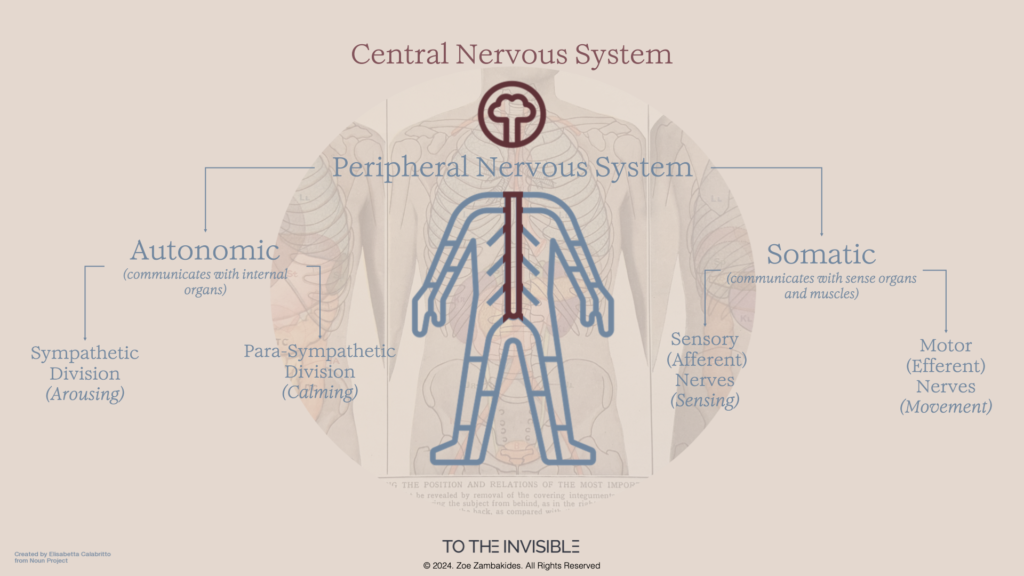
Neuroception: the invisible scan your system is running every millisecond
“By processing information from the environment through the senses, the nervous system continually evaluates risk. ”
– Stephen Porges (2004)
Your autonomic nervous system works constantly to keep you safe. Stephen Porges calls this constant scanning neuroception: the intake of that information, running every millisecond, whether you’re aware of it or not. Neuroception is the mechanism your nervous system uses to scan for cues of threat or safety — but your nervous system is the one making the call on how it needs to kick into action and it makes that call based on your own individual history and past experience. What registers as danger for you might register as nothing at all for someone else and vice versa.
When your system reads comfort, your parasympathetic nervous system settles you into calm — the only state in which you can truly rest and repair. When it reads threat, your sympathetic nervous system puts you on alert, whether or not the threat is real or current. (More in Article 4 about why that is).
‘Because of our heritage as a species, neuroception takes place… without our conscious awareness… Even though we may not be aware of danger on a cognitive level, on a neurophysiological level, our body has already started a sequence of neural processes that would facilitate adaptive defense behaviours… Neuroception explains why a baby coos at a caregiver, but cries at a stranger and why a toddler might enjoys a parents embrace but can feel a hug from a stranger as an assault’. (Porges, 2004)
Our nervous system’s current experience shapes how we feel and how we see – and experience- the world
It’s why unconsciously, your body might neurocept the tiniest cue that causes it to run an alert far beyond your conscious awareness.
We already read in #2 about how our body can detect stress in others and how it shapes our opinion of them. (More about this in #4).
If you don’t take your nervous system’s current state into account, discerning which instincts to trust is close to impossible — you’re working with half the picture, and it’s the half most likely to mislead you.
Just like your nervous system picking up on the cortisol levels in someone else’s sweat, your conscious Self might be blissfully chatting away in your meeting or going about your business — maybe just feeling a little more stressed than usual, but probably not noticing because you’re busy, meanwhile your Embodied Self might have something very different to tell you. Often your nervous system can miscalculate what is happening; we’ll understand more why in the next post, so understanding the current state of our nervous system is critical to having a clearer perspective on what we’re perceiving in the moment.
Your nervous system’s current state shapes what you notice, how you interpret it and how you respond — long before you’re consciously aware any of that happened. Maybe your new colleague reminds your system of someone from years ago. Maybe a tense meeting activates a pattern laid down in a classroom decades earlier. Your conscious self might be sitting there, apparently calm, while your nervous system runs an entirely different program underneath.
The work is learning to sync with your nervous system — to notice its current state, re-orient and choose your response from a place of regulation, rather than reacting unconsciously to a threat you don’t even know you’re perceiving.
And a genuine note: noticing you’re activated and telling yourself to calm down rarely works. Regulation is a practice, not an instruction you give yourself mid-meeting.
“Contemporary strategies for health and wellbeing fail our biological needs by not acknowledging that feelings of safety emerge from internal physiological states regulated by the autonomic nervous system”
– Stephen Porges (2004)
If you don’t take your nervous system’s current state into account, discerning which instincts to trust is close to impossible — you’re working with half the picture and it’s the half most likely to mislead you.
So we’ve learned there are three steps thus far:
- Paying close attention to the present moment as it is
- checking in with our embodied awareness and the wider information available through our whole system – not just thinking
- Learning to notice what state our nervous system is in.
The next stage: discerning if your nervous system — whose job is to keep you in the familiar and the safe — is working off old data or not. Read on to Principle #4 to understand how this shapes your expectations and how you see the world.
I feel so passionately about this because the majority of paradigms in personal and professional development talk about this very superficially – and it’s why I created PAUSE to help you learn to do those first three steps. it isn’t quick work but if you want to develop instincts you can really trust, this is what you need to do.